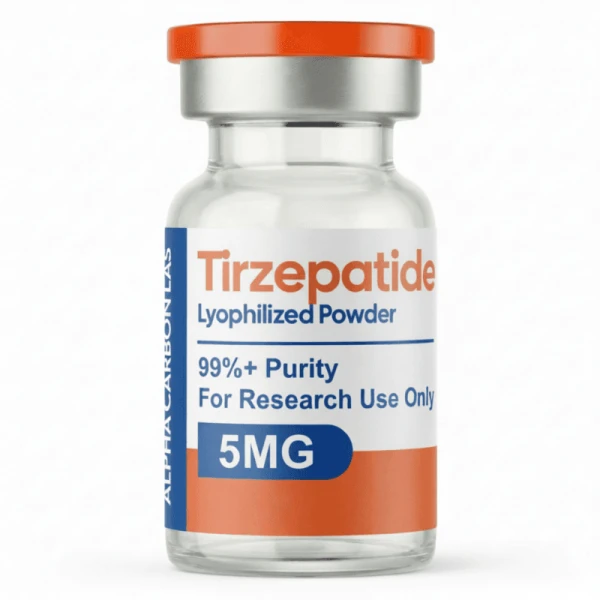
Description
Tirzepatide Research Peptide for Sale
tirzepatide peptide for sale Tirzepatide research peptide is a synthetic 39-amino-acid peptide studied as a dual GIP and GLP-1 receptor agonist. Research focuses on dual incretin receptor activation and its relationship with glucose metabolism, energy balance, and other nonclinical research models.
This material is supplied for in vitro and other nonclinical laboratory research only. It is not intended for human or veterinary use, consumption, administration, therapeutic use, or diagnostic use.
What Is Tirzepatide?
Tirzepatide is a synthetic 39-amino-acid peptide that engages both GIP and GLP-1 receptors.
Researchers study tirzepatide because it activates two incretin receptor pathways. This dual activity provides a research model for examining GIP and GLP-1 signaling.
Research also examines how dual receptor activation relates to pathways involved in glucose metabolism and energy balance.
For researchers looking for tirzepatide research peptide, the product offers a defined molecular target and research context.
Tirzepatide Dual GIP and GLP-1 Receptor Activity
Tirzepatide acts as an agonist at both GIP and GLP-1 receptors.
This dual receptor activity is a central part of tirzepatide research. Researchers can examine how combined GIP and GLP-1 receptor activation differs from single-receptor activation.
Research therefore focuses on the interaction between these two incretin pathways.
The supplied information describes tirzepatide as a compound in the class of dual incretin receptor agonists.
Tirzepatide Molecular Design
Tirzepatide has a modified molecular structure.
The peptide contains a C20 fatty diacid moiety. This structural modification promotes reversible albumin binding.
In laboratory models, this interaction extends the circulating half-life of the peptide.
Therefore, molecular design is an important part of research involving tirzepatide.
Key Molecular Features
- Synthetic peptide
- 39 amino acids
- GIP receptor agonist
- GLP-1 receptor agonist
- Dual incretin receptor activity
- C20 fatty diacid modification
- Reversible albumin binding
- Studied in laboratory models
Tirzepatide Mechanism of Action
Tirzepatide functions as an agonist at GIP and GLP-1 receptors.
Research investigates how activation of these receptors affects pathways related to glucose metabolism and energy balance.
This dual activity provides a research model for studying incretin signaling.
Researchers can also compare dual receptor activation with single-receptor approaches.
Tirzepatide Research Applications
Tirzepatide research covers several nonclinical areas.
These include:
- Dual GIP/GLP-1 receptor agonism
- Glycemic regulation models
- Insulin resistance models
- Adipose tissue biology
- Lipid metabolism
- Cardiovascular signaling
- Hepatic steatosis models
- Comparative incretin analogue studies
These applications describe research areas. They do not establish that this particular material will produce a specific experimental outcome.
Tirzepatide and Glucose Metabolism Research
Glucose metabolism is an important area of tirzepatide research.
Researchers examine how dual GIP and GLP-1 receptor activation relates to pathways involved in glucose regulation.
This research can use different experimental models and study designs.
Results from one experimental system should not automatically be applied to another preparation.
Tirzepatide and Energy Balance Research
Research also examines tirzepatide in relation to energy balance.
The dual receptor activity of tirzepatide provides a model for studying how GIP and GLP-1 signaling interact.
Researchers may investigate these pathways alongside other metabolic research areas.
The specific experimental design determines which observations are relevant to a particular study.
Tirzepatide Research Peptide for Laboratory Use
This material is supplied solely for in vitro and other nonclinical laboratory research.
It is not intended for:
- Human use
- Veterinary use
- Consumption
- Administration
- Therapeutic use
- Diagnostic use
Researchers should follow applicable institutional procedures when handling research materials.
They should also use appropriate laboratory controls, personal protective equipment, storage conditions, and disposal procedures.
Research Findings and Literature
Published nonclinical literature can provide useful information about tirzepatide’s molecular targets and experimental models.
However, researchers should review each study independently.
Findings involving other preparations, experimental systems, or study populations do not establish the identity, performance, or suitability of this specific research material.
Why Researchers Study Tirzepatide
Tirzepatide provides a research model involving two incretin receptor pathways.
Its research relevance comes from several features:
- Dual GIP and GLP-1 receptor activity
- Defined 39-amino-acid structure
- C20 fatty diacid modification
- Reversible albumin binding
- Research involving glucose metabolism
- Research involving energy balance
- Comparative incretin research
These characteristics make tirzepatide relevant to research involving incretin receptor signaling and metabolic models.
Tirzepatide Research Material: Important Limitations
Research results can vary between experimental systems.
A published observation does not automatically establish the identity or performance of another preparation.
For this reason, researchers should verify the available product information and determine whether the material is suitable for their intended experimental design.
The purchaser is responsible for study design, laboratory handling, disposal, and regulatory compliance.
Tirzepatide Research Peptide for Sale Online
If you are searching for a tirzepatide research peptide for sale, this material is described as a synthetic 39-amino-acid peptide with dual GIP and GLP-1 receptor activity.
Related commercial searches may include:
- Tirzepatide research peptide
- Tirzepatide peptide for sale
- Tirzepatide research material
- Tirzepatide peptide online
- Buy tirzepatide research peptide
- Tirzepatide laboratory research peptide
- Tirzepatide 39 amino acid peptide
- Tirzepatide GIP GLP-1 peptide
Always review the available specifications and research-use limitations before ordering.
Frequently Asked Questions
What is tirzepatide?
Tirzepatide is a synthetic 39-amino-acid peptide studied as an agonist at both GIP and GLP-1 receptors.
What receptors does tirzepatide target?
Tirzepatide engages both GIP and GLP-1 receptors.
How many amino acids are in tirzepatide?
The supplied information describes tirzepatide as a 39-amino-acid peptide.
What is tirzepatide studied for?
Research applications include dual receptor agonism, glycemic regulation models, insulin resistance models, adipose tissue biology, lipid metabolism, cardiovascular signaling, hepatic steatosis models, and comparative incretin analogue studies.
What is the C20 fatty diacid moiety?
The C20 fatty diacid moiety is part of tirzepatide’s molecular design. It promotes reversible albumin binding.
Is tirzepatide used in laboratory research?
The supplied material is intended solely for in vitro and other nonclinical laboratory research.
Is this tirzepatide material for human use?
No. The supplied information states that it is not intended for human or veterinary use, consumption, administration, therapeutic use, or diagnostic use.
Can published research results be applied directly to this material?
Not necessarily. Results involving other preparations or experimental systems do not establish the identity, performance, or suitability of this specific research material.
Research Use Only
This tirzepatide research peptide is supplied solely for nonclinical laboratory research.
It is not intended for human or veterinary use, consumption, administration, therapeutic use, or diagnostic use.
Researchers are responsible for appropriate study design, handling procedures, disposal, and regulatory compliance.




Reviews
There are no reviews yet.